Author: Serena Datta | BHSc Student at Queen’s | TNO Community Ambassador Under the sweltering heat in the Kantamanto market, young kayayei, Ghanaian female head porters, carry the burden of our waste on their heads; transporting 100 pound bales of textile waste from importers to retailers¹. The Kantamanto Market in Accra, Ghana, is West Africa’s largest hub for second-hand clothing¹. Inundated with cramped market stalls, merchants, and clothing waste from the West, the market is the epitome of waste colonialism.....
April 2026

Author: Serena Datta | BHSc Student at Queen’s | TNO Community Ambassador
Under the sweltering heat in the Kantamanto market, young kayayei, Ghanaian female head porters, carry the burden of our waste on their heads; transporting 100 pound bales of textile waste from importers to retailers¹. The Kantamanto Market in Accra, Ghana, is West Africa’s largest hub for second-hand clothing¹. Inundated with cramped market stalls, merchants, and clothing waste from the West, the market is the epitome of waste colonialism.
Behind Accra’s waste crisis lies seemingly impossible logistics; in a country of 30 million, Ghana equally receives 30 million articles of clothing arriving every fortnight from the Global North². This weekly influx of what locals call Obroni W’awum, "dead white man's clothes", is causing an overwhelming amount of waste to oversaturate the landfill of Kpone and pollute beaches². Textile waste is a public health crisis, clogging gutters and becoming a breeding ground for malaria and cholera.
This is the unpalatable secret behind our fast-fashion addiction.
Waste Colonialism and Global Trade
Many of the clothes we give to charity or to recycling plants are sold and exported to textile distributors for markets in developing nations. Canada alone contributes over $173 million worth annually to this global trade³.
But how exactly is the Kantamanto market able to re-purpose the thousands of metric tons of our unwanted fashion? What can we learn from their approach to handling our textile waste?
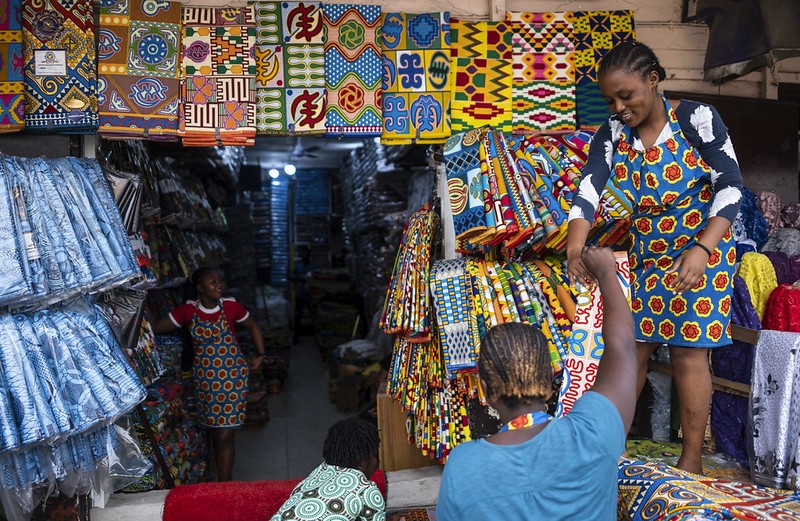
Figure 1: Stephanie Ocho (right) arranges African print fabrics at a store in Kantamanto market. “Ghana” by International Monetary Fund, CC BY-NC-ND 2.0
Reclaiming Creativity Over Consumption
The Kantamanto upcycling culture is something to be admired in many ways. It is a bustling hive of innovation and resourcefulness, recirculating 100 million items every 4–5 months¹.
The important lesson here is recognising the power in reclaiming creativity over consumption. Ghanaian shoppers have a less transactional relationship with fashion and view clothing as a material they can recreate and reconstruct, whereas we tend to simply define ourselves as 'consumers'. Ghanaian merchants repurpose the textile waste they receive into colourful purses, hats and even jewelry. They find utility in the unwanted.
Why Recycling Isn’t Enough
This creative upcycling approach challenges the West's prevailing assumption that recycling alone is the answer to achieving a circular economy. The real harm lies not in recycling itself, but in the mindset it enables—the seductive belief that simply dropping clothes in donation bins absolves us of responsibility for our purchasing choices.
Upcycling, however, accomplishes two of the three "R"s of recycling: reduce and reuse. It transforms materials into higher-quality products, whereas traditional recycling often degrades material quality through chemical and mechanical processes.
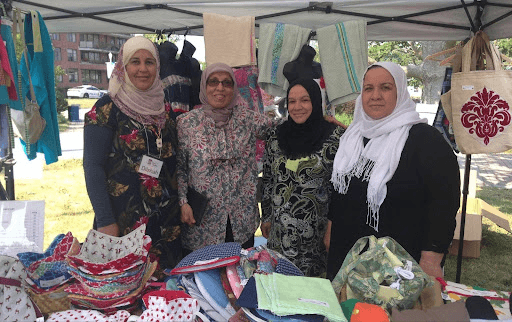
Graduating participants Dilsha, Zakia, Khadija, and their instructor Emine (second from left) display handmade items at Multicultural Canada Day Festival 2018. | Photo Credit: New Canadians Centre
Sew TO: Meet Fatima Khote!
Closer to home, the Sew TO Women’s Collective shows how this creativity-over-consumption model can look like in urban neighborhoods. Operating out of the sewing hub at 10 Gateway Boulevard, the group brings immigrant and low-income women together to turn donated fabric into masks, bags, pouches, and small household items.
Coordinator Fatima Khote has been with the collective since the early days of the pandemic, when members were sewing two- and three-layer masks to high-barrier four-layer masks made in partnership with Frett for Michael Garron Hospital.
After COVID-era mask production slowed, Fatima helped shift the group’s focus to other household items and accessories. “We began making handbags out of old jeans, pot holders, and small home items,” she explained. “It gave members a chance to learn new skills and also kept good fabric out of the waste stream.”
But sustaining this work has not been easy. Textile donations have decreased, and Sew TO now faces challenges sourcing the material needed for upcycling. “We need more funds,” Khote said. “The textile donations aren’t really coming in now, and without fabric, we can’t keep making things.
Despite these challenges, Khote continues to highlight the creativity and commitment of women working out of the sewing hub. When asked about her favourite projects and what makes it meaningful for her, she pointed to the value members place on their work. “Because it is something that we make. “It’s coming out of Sew TO. It’s our piece of work, and we put so much valuable time in it.” she said.
The hub also supports skill-building and peer learning. Khote describes how members collaborate: "Some people had the knowledge of sewing but didn't have the skills to do it. We all put our knowledge and skills together, and so much has come out of it."
For many members, the hub offers a space to learn, contribute, and build community through shared work. “We welcome everybody to the sewing hub,” Khote said.“Whoever wants to learn, come on in. We will teach you, and we will give you the space to learn.”
Changing How We Think About Consumption
The lessons from both Kantamanto and community hubs like Sew TO show that reducing textile waste involves more than recycling bins and donation drives. To decolonise and decentralise fast-fashion, we need a drastic shift in our consumerist culture, especially towards a larger second-hand economy.
Much too often are we a consumer, a blind pursuer of trends, and so rarely a human.
How You Can Support Local Upcycling This Spring
Community members who wish to support local upcycling efforts can donate clean, reusable fabric to the Youth Hub at 45 Overlea Boulevard. These materials help sustain programs like Sew TO and provide hands-on learning opportunities for women and youth in the neighbourhood.
Those interested in joining the collective can email Sew TO at SewTO@tno-toronto.org
References
1. Penny D. The dirty secrets of the global north’s old clothes [Internet]. 2023 [cited 2025 Nov 27]. Available from: https://newlinesmag.com/reportage/the-dirty-secrets-of-the-global-norths-old-clothes/
2. Besser L. Dead white man’s clothes [Internet]. 2021 [cited 2025 Nov 27]. Available from: https://www.abc.net.au/news/2021-08-12/fast-fashion-turning-parts-ghana-into-toxic-landfill/100358702
3. Jay P. Here’s where your donated clothing really ends up | CBC News [Internet]. CBC/Radio Canada; 2018 [cited 2025 Nov 27]. Available from: https://www.cbc.ca/news/canada/ottawa/donated-clothing-where-it-ends-up-1.4662023